

Ready to get involved?
Learn how to participate in MINISTP or apply for T32 support.
Overview
Mechanisms Integrating Nervous and Immune Systems Training Program (MINISTP) is a new T32 funded by the NIAID (T32AI200944; 2026) in response to a growing interest in interdisciplinary research on neuroimmunology among our trainees and faculty.
The program aims to organize local experts in immunology and neuroscience into a cohesive community of mentors who can provide immersive training for emerging scientists in the conceptual, technical, and workplace skills required to become proficient in “dual-topic research” in neuroimmunology.
To learn more about training opportunities, visit the Academic Curriculum page.
Background
The immune and nervous systems are arguably two of the most complex organ systems in our body. Over the years, our increasingly detailed molecular and cellular understanding of both systems has also had the unfortunate side effect of siloing their studies into distinct specialties with their own niche concepts, jargon, and methodologies. However, it is also clear now that these systems affect each other’s functioning in fascinating ways. Immune cells affect behavior by influencing the development and function of the brain. Neural activity and responses to behavioral cues can also modify immunity to infections and tumors. Reflexes in the peripheral nervous system are often key components of innate immunity.
Indeed, understanding the mechanisms by which immune and nervous systems regulate each other’s functioning is not only important for developing a complete picture of how our bodies operate but also has significant clinical implications. Many psychiatric disorders involve immune cell contributions. At the same time, immunity to infections can trigger long-term neurological symptoms, as evident in some forms of lyme disease and long COVID. Competitive contemporary approaches to study these topics will require scientists trained to think about concepts in both neuroscience and immunology, capable of designing experimental strategies that seamlessly bridge both disciplines.
Meet the faculty involved in this work on the Program Leadership & Training Faculty page.
Training Philosophy
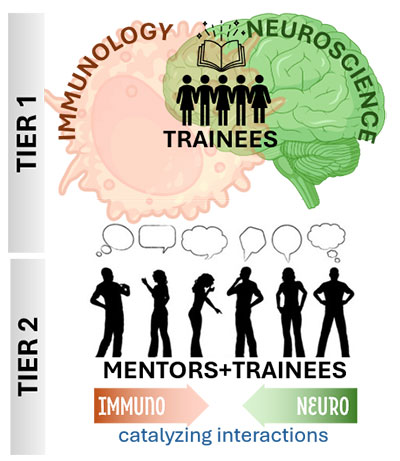
We expect that training such dual-topic researchers will require a two-tiered effort.
 Tier 1
 Tier 1
Tier 1 involves instructional and subject-matter support for the trainees. Towards this, MINISTP envisions new courses specifically designed to introduce both neuroscience and immunology, workshops that expose trainees to techniques required for examining functions of both systems, modules designed to improve communication and collaboration as well as instill rigor and discipline in the conduct of science.
Tier 2
Tier 2 is more nuanced. The philosophy here is that in science, creative thinking and the accumulation of tacit experiential acumen about the field require more than just instructions or training. Active intellectual engagement on the topics - discussions, debate, and exchange of ideas with peers and a community of mentors - is critical in the maturation of trainees and the honing of their interdisciplinary skills.
Such engagements allow trainees to not only practice the “language” they learn in the didactic training components of the first tier but also sharpen their ideas and develop an independent interdisciplinary philosophy.
Towards this end, Tier 2 components in MINISTP will involve a series of mechanisms for community building. We will roll out interactive forums and meetings to encourage informal and formal discussions among MINISTP mentors in Immunology, Neuroscience, and Neuroimmunology, as well as visits from external experts.
These concerted efforts, reflecting the ethos that “it takes a village” (to train an interdisciplinary scientist), are expected to enhance the impact of MINISTP on the overall academic environment around neuroimmunology at UMB, not just for the trainees directly supported by the T32 fellowship.
Interested in participating?
Visit the Who Should Participate page.
Ready to apply?
See the Application Process page.